Contents
The principle: sort first, remove second
In a house clearance, sorting is how each category ends up in the right place. We work in this order of priority:
- What the family keeps: keepsakes, photos, papers, jewellery and anything of sentimental value. These are set aside before anything leaves the house.
- Reuse: anything that can still be used as it is goes to charities, social economy enterprises or second-hand shops.
- Recycling: wood, metal, cardboard, electrical appliances and worn-out textiles go into their own recycling streams.
- Disposal: only waste with no other outlet ends up as residual waste.
This is how we handle every house clearance in Brussels: sorting is done on site, room by room, and you tell us at the visit what you want to keep.
Which charities accept donations in Brussels?
The Brussels-Capital Region names five authorised and subsidised social economy enterprises for collection and reuse: Les Petits Riens, La Poudrière, the Salvation Army, Terre and Oxfam-Solidarité. Brussels Environment (Bruxelles Environnement) also lists Cyclup among the Brussels reuse organisations. The Ressources federation, which brings together reuse centres in Wallonia and Brussels, publishes a map of second-hand shops and textile banks on its website.
Each organisation sets its own rules. A few practical points, checked on their websites:
- Les Petits Riens accepts furniture in good condition up to 2 metres, depending on its needs and the space available, as well as textiles, books, kitchenware and household appliances, even if they no longer work. The charity says it no longer collects from people's homes: you have to drop donations off yourself at one of its drop-off points.
- Oxfam second-hand shops mainly take clothes, shoes, books, kitchen utensils and decorative items in good condition. Large furniture is generally not accepted.
- Clothing banks run by social economy organisations (Petits Riens, Terre and others) can be used day and night, for clean, dry textiles packed in a closed bag.
One important point: a donation is never guaranteed. A charity can turn down a piece of furniture that is damaged, too large or simply not needed at the time.
What we do with items in good condition
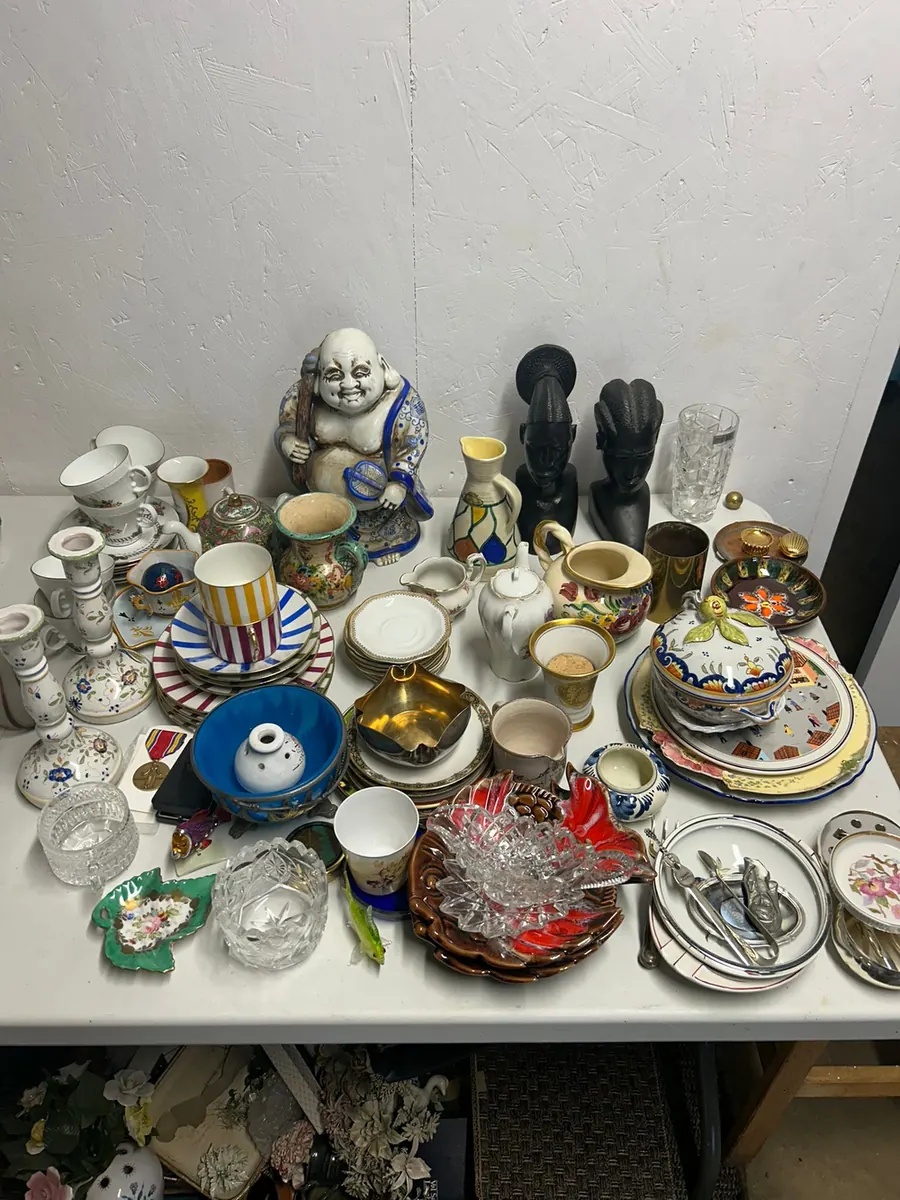
The organisations mentioned in this article are named for information only: AAB Brocanteur has no partnership with any of them. During the clearance, anything in good condition (sturdy furniture, complete sets of crockery, books, clean linen, working appliances) is put aside and offered to charities, depending on what they accept. Whatever does not find a taker goes to recycling, not straight into the bin.
If you would like a particular item to go to a particular charity, tell us at the visit and we will keep it aside on the day.
We work this way on every job: house clearance after a death, flat clearance, and also attics and cellars, where forgotten items in very good condition often turn up.
Table: where does each type of item go in Brussels?
| Item | If in good condition | If damaged or no longer usable |
|---|---|---|
| Furniture (wardrobes, tables, chairs) | Donate to a charity or a second-hand shop | Bulky waste: Recypark or Bruxelles-Propreté home collection; wood and metal separated for recycling |
| Large and small appliances, TVs, computers | Donate (some charities accept them even if broken) | Recupel stream: collection point, Recypark, or take-back by the shop when it sells you a similar new appliance |
| Clothes, household linen, shoes | Textile bank or second-hand shop | Textile bank if clean and dry; white bag if wet or soiled |
| Books, crockery, ornaments | Second-hand shop or charity | Glass, paper and cardboard, or residual waste, depending on the material |
| Mattresses | Rarely accepted as a donation | Valumat collection point or Recypark |
| Paint, solvents, cleaning products, batteries | Never as a donation | Proxy Chimik or Recypark |
The exact rules (quantities, opening hours, items refused) change regularly, so always check the organisation's website before you set off.
Electrical appliances: the Recupel scheme
In Belgium, used electrical and electronic appliances (fridges, washing machines, microwaves, televisions, computers, drills, lamps) never go in the white bag or out with ordinary bulky waste. They go through the Recupel scheme, which organises their collection and recycling.
- Recupel says there are around 300 collection points in Brussels: supermarkets, electrical shops, DIY stores and Recyparks.
- The Bruxelles-Propreté Recyparks take back all types of electrical appliances free of charge.
- When a shop sells you a new appliance, it must take back your old, similar one free of charge, even if it is broken and even if it is a different brand or came from another shop. The appliance must be complete and must not have been taken apart.
- An appliance that still works can be donated first, or dropped off at a reuse centre.
Clothes and textiles: textile banks and second-hand shops
Bruxelles-Propreté has a textile bank at each of its Recyparks, and social economy enterprises put others on public streets and on private land. The Ressources federation's map helps you find the nearest one.
Textile banks accept clothes, household linen, shoes (tied together in pairs), leather goods and soft toys. The rules are simple:
- textiles must be clean and dry, even if they have holes;
- packed in a closed bag;
- wet, mouldy or soiled textiles go in the white bag, because they ruin the whole contents of the bank;
- never leave bags at the foot of a full textile bank: that counts as fly-tipping and can lead to a fine.
Hazardous waste: Proxy Chimik and the Recypark
Cellars, garages and workshops often hide tins of paint, cans of oil, solvents, garden products or batteries. This household chemical waste cannot go in the bags, out with bulky waste or down the drain.
- Proxy Chimik is the Bruxelles-Propreté service that collects small amounts of household chemical waste at temporary drop-off points, on a timetable published municipality by municipality. Any container that still holds product and carries a hazard symbol (corrosive, toxic, flammable, harmful to the environment and so on) should be taken there.
- The quantities accepted are limited per visit, and some products are refused, such as asbestos or gas bottles: check the current list on the Bruxelles-Propreté website.
- Used mineral oil (engine oil) must be taken to the Recypark.
Keep each product in its original, tightly closed container, and never mix two products. If a parent's cellar holds a lot of them, mention it at the visit: we keep them apart from everything else, and it is sometimes simpler for the family to take some of them to a Proxy Chimik point before the clearance.
Bulky waste: Recypark and home collection
For private households, Bruxelles-Propreté offers two options for bulky waste (unusable furniture, large items):
- the Bruxelles-Propreté Recyparks (Buda in Neder-Over-Heembeek, Demets in Anderlecht, Humanité and Sud in Forest) and the mobile Recyparks run with some municipalities, on presentation of your identity card;
- home collection, booked by phone on 0800 981 81, with a free volume per household per year (3 m³ according to Bruxelles-Propreté) and any extra charged.
These options work well for a few pieces of furniture. They are for private households only and take time, a car or someone at home. When it comes to emptying a whole house, carrying a wardrobe down from a third floor with no lift or clearing out a full cellar, calling in a company is often the more realistic choice. For just a few items, see our junk removal service in Brussels.
What you can do before the house clearance
- Set aside what the family is keeping: photos, papers, jewellery, family heirlooms. Close off one room or label the boxes.
- Pick out the donations you want to make yourself and contact the charity first: it will tell you whether it accepts the item.
- Point out hazardous products (paint, cans, garden products) and electrical appliances at the visit.
- Use the shop take-back if you are getting a new household appliance.
- Ask for a written quote: the visit and quote are free, and the price is fixed in writing before the job. What affects the price is explained on our prices page.
Once the rooms are empty, a simple clean (sweeping, vacuuming, mopping) can be requested at the visit and included in the quote: see cleaning after a house clearance.